Street Map Of Angra Do Heroismo Free Download And Print
| Angra do Heroísmo | |
|---|---|
| Municipality | |
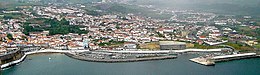
| Clockwise: View of Monte Brasil; typical street in Angra; view of São Mateus da Calheta; panoramic view of Angra; Fortress of São João Baptista; Igreja da Misericórdia. | |
| Flag Coat of arms | |
 Location of the municipality of Angra practice Heroísmo in the archipelago of the Azores | |
| Coordinates: 38°39′20″N 27°xiii′10″Westward / 38.65556°Northward 27.21944°Due west / 38.65556; -27.21944 Coordinates: 38°39′twenty″N 27°13′10″W / 38.65556°Northward 27.21944°W / 38.65556; -27.21944 | |
| State |  Portugal Portugal |
| Auton. region | Azores |
| Island | Terceira |
| Established | Municipality: c. 1478 |
| Parishes | 19 |
| Government | |
| • President | José Gabriel practise Álamo de Meneses |
| Surface area | |
| • Total | 239.00 kmii (92.28 sq mi) |
| Elevation | 31 m (102 ft) |
| Population (2011) | |
| • Total | 35,402 |
| • Density | 150/kmii (380/sq mi) |
| Time zone | UTC−01:00 (AZOT) |
| • Summer (DST) | UTC±00:00 (AZOST) |
| Postal code | 9701-101 |
| Area code | 292 |
| Patron | São João |
| Local holiday | 24 June |




| UNESCO World Heritage Site | |
|---|---|
| UNESCO World Heritage Site | |
| Official name | Key Zone of the Boondocks of Angra do Heroismo in the Azores |
| Criteria | iv, 6 |
| Reference | 206 |
| Inscription | 1983 (7th Session) |
Angra practise Heroísmo (Portuguese pronunciation: [ˈɐ̃ɡɾɐ du eɾuˈiʒmu] (  listen )), or simply Angra,[ane] [2] is a city and municipality on Terceira Isle, Portugal, and ane of the three capital cities of the Azores. Founded in 1478, Angra was historically the nearly important urban center in the Azores, equally seat of the Bishop of the Azores, government entities, and having previously served as the majuscule city of Portugal during the Liberal Wars. The population in 2011 was 35,402,[3] in an area of 239.00 km².[four] Information technology was classified every bit a Globe Heritage site by UNESCO in 1983.
Proper noun [edit]
Angra is the Portuguese word for "inlet", "cove", or "bay". The epithet do Heroísmo ("of Heroism", "the Heroic") was granted to the city past Maria Two to commemorate its citizens' successful defense force of the island against a Miguelist assault in 1829.[2]
History [edit]

1595 Engraving past Jan Huygen van Linschoten, showing the extensive cultivated lands of the Achada Manifestly and the nucleus of the village of Angra

Angra practice Heroísmo as seen in 1671

An engraving of Angra showing the Fort of São João Baptista
Some claim that Angra was founded by Álvaro Martins, who sailed with Didrik Pining on his expedition to the New Earth, and with Bartolomeu Dias on his voyage around the Cape of Good Hope. Others contend that Angra was founded in 1450 or 1451 past Jácome de Bruges, a Fleming in the service of Prince Henry the Navigator, who recruited farmers, fishermen, and merchants in the Depression Countries to colonize the Azores.
The start references to the settlement of the Azores date to between 1439 and 1449, through the donation of Henry the Navigator the colonization of vii islands in the central and eastern groups of the archipelago. Terceira, included in this grouping, would be administered by Jácome de Bruges as stipulated in the nomination process, dated March 1450, that included not only the settlement of the lands, but as well the milling monopoly, ovens, salt concession, land rights in the name of the monarchy, tithes, administration of justice, and rights of succession including the exceptional provision for materlineal succession. Merely, the great difficulty in alluring settlers meant that by 22 August 1460, the island was still unpopulated.
The site called by the first settlers was a ridgeline, which opened, like an amphitheatre, onto two small bays, separated past a peninsula, at the caput of which stood the extinct volcano of Monte Brasil. One of these coves was deep plenty (around 40 m or 130 ft) to provide an anchorage for large vessels, and information technology had the farther advantage of existence sheltered from most strong winds, except for those from the southward and southeast.
In 1474, Álvaro Martins Homem ordered that the river flowing into the cove exist diverted into a manmade stone-lined channel, running downhill, and then that its rushing waters could be harnessed to turn the waterwheel of a mill. This laid the foundation for the future economical development of the village of Angra. At the same fourth dimension, this allowed the area on either side of the river's course to be rearranged according to a rectilinear street-plan and organized into neighborhoods by part (commercial, residential, etc.), to adapt the needs of the fast-growing port. The first houses of Angra were built on the hillside above the cove, the steep streets winding down to the shore. On high footing, away from the sea, a castle/stronghold/fortress was begun; it would somewhen be named Castelo dos Moinhos (English: Castle of the Mills). Past 1534, Angra was the beginning town in the archipelago to be elevated to the status of metropolis. In the same year, information technology was called by Pope Paul Iii to be the seat of the Diocese of Angra, with ecclesiastical authorization over all of the islands of the Azores.
The commercial port of early Angra played an of import role in the Portuguese East Indies trade kickoff in the 15th Century. The bay of Angra was often full of caravels and galleons, a circumstance that contributed to the progress of the city and its people. The construction of a number of manors, convents, churches, and armed services fortifications in Angra, infrastructures that were unremarkably inappropriate for a small-scale city (or small island) indicates the important function that Angra played in trans-Atlantic shipping for the Portuguese. The Portuguese nobleman Pero Anes do Canto (1480–1556), who was born at Guimarães, was the superintendent of fortifications on Terceira. For his competency in that role, and other services to the Portuguese Crown, he was rewarded with the title moço fidalgo (knight-gentleman), and the high role of "Purveyor to the Armada of the Islands and the merchant vessels of the East India trade in all of the islands of the Azores" (a hereditary championship that followed successive members of the Canto family for three hundred years). The importance and ability of the Cantos can hardly exist overstated. During the period when Portugal was trading with its Asian, African, and South American colonies, they were responsible for the protection and welfare of the merchant fleet (and the staggering wealth represented by the cargoes in their holds) once the ships approached the terminal leg of their voyages in the North Atlantic. They were besides responsible for acting as the principal community official, the master magistrate charged with resolving disputes, and the overseer of the naval defenses of the Azores.
Portuguese succession [edit]
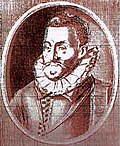
King António, Prior of Crato, who ruled Portugal from Angra during the 16th-century succession crisis
Before Philip Two of Spain had a chance to enforce his claim to the crown of Portugal, in 1580, António, Prior of Crato, an illegitimate scion of the Beja line of the Firm of Braganza Portuguese Royal Family, proclaimed himself king on 24 July 1580. However, his dominion in continental Portugal lasted only 20 days; on 25 August, he was defeated at the Battle of Alcântara by the Castilian Habsburg armies led past Fernando Álvarez de Toledo, Knuckles of Alba.
After Alcântara, he attempted to dominion Portugal from the Azores, where he established an opposition government in Angra exercise Heroísmo that lasted until 1583. Although for a time he was the monarch (minting coin and conferring titles), his government on Terceira was only recognized in the Azores, and from that place of refuge, António conducted a popular resistance movement opposed to the recognition of a foreign male monarch. He was supported past a number of French adventurers nether Filippo di Piero Strozzi, a Florentine exile in the service of France, as well as Portuguese patriots, some of whom came to the Azores to assist him directly.
- Battle of Salga Bay
The start military action in the Azores occurred about a twelvemonth after António's burdensome defeat at Alcântara. A Castilian armada of ten warships, allowable by Pedro Valdez, bombarded Angra on 5 July 1581, then began investigating the declension of the isle in search of the best landing places. At dawn on 25 July, the outset ships loaded with Spanish troops anchored in Salga Bay, about twelve kilometres east of Angra's harbour in the village of Vila de São Sebastião. A coastwatcher, stationed at the greatcoat called Ponta do Coelho, gave the alert, only when the start Portuguese forces arrived about one chiliad Castilians had already landed and had started to sack the surrounding villages. In this phase of the fighting, according to local accounts of the action, a leading role was played by immature and pretty Brianda Pereira who, together with other women, attacked the enemy with farm implements when she saw her house destroyed.
By midmorning, the Spaniards were sweeping the coast with their artillery, and the fighting was tearing. About midday, when the outcome of the battle was still unsettled, an Augustinian monk named Friar Pedro, who was taking an active part in the struggle, idea of the stratagem of driving cattle against the Spaniards so equally to scatter them. Over a thousand head of cattle were quickly gathered and, by means of shouts and musket shots, driven against the enemy positions. The disconcerted Spaniards fell back and were pursued to the shore, where virtually all of them lost their lives in the fighting or drowned while trying to attain their boats. This unconventional victory, the Battle of Salga Bay, proved that António could count on a good deal of local support.
- Battle of Ponta Delgada
The side by side major military action did non accept place until the following summer. Álvaro de Bazán, 1st Marquis of Santa Cruz, was sent in 1582, every bit "Admiral of the Sea", to drive the pretender and his supporters from Angra and the Azores. Badly outnumbered, he won the Battle of Ponta Delgada on 26 July 1582, off the declension of the island of São Miguel, against a loose confederation of Portuguese, French, English language, and Dutch privateers.
- Boxing of Terceira
Although António's fleet was completely defeated at the Battle of Ponta Delgada, the pretender did flee into exile in France later on the battle. His supporters were afterwards defeated the following year at the Battle of Terceira, near Angra, on 27 July 1583, which allowed Philip'due south forces to finally occupy the Azores and complete his unification of the Crowns of Spain and Portugal. Even so, Santa Cruz, the Spanish admiral, who was acclaimed for his victories confronting the House of Aviz and its partisans in the Azores, recognized that England presented a grave threat to Kingdom of spain's empire, and he became a zealous advocate of war with the English. A letter he wrote to Philip Ii from Angra exercise Heroísmo, on 9 Baronial 1583, two weeks after the Battle of Terceira, contains the first definite suggestion of the formation of the Castilian Armada.
Information technology was following the events of the boxing of Terceira that the existing fortifications in Monte Brasil were rethought. During the Anglo-Spanish War (1585–1604), the original Portuguese fortifications were redesigned by Italian military engineer Giovanni Vicenzo Casale and his assistants, since privateers, such as Francis Drake and Walter Raleigh, had attacked Spanish ships and possessions. The first cornerstone was laid in 1583, and the fortifications were progressively elaborated to include several bastions and cannon emplacements. By the Restoration, the Castilian commander, Álvaro de Viveiros, resisted for eleven months (from 27 March 1641 to 4 March 1642) behind the walls of the impregnable fortress, and only a concentrated task forcefulness allowable by Francisco Ornelas da Câmara and João de Bettencourt were able to defeat the commander. The fort was taken, and reclaimed for Portugal: a church was constructed within the fortress in accolade of Saint John the Baptist (Portuguese: São João Baptista) afterwards 1642.
17th century [edit]

A young Almeida Garret, during the Napoleonic invasions escaped, along with his family to Angra, where they remained until English forces liberated the Iberian peninsula

After a fourth dimension in London, former Emperor Pedro I of Brazil joined liberal forces in Angra practise Heroísmo, where he fabricated a base for his eventual assault on the continent during the Liberal Wars
Over the years, Terceira (and Angra in particular) has been a pop place for out-of-favor monarchs to cool their heels while events on the Portuguese mainland or elsewhere went on without them. In 1667, near the end of the Portuguese Restoration War, Rex Afonso Half dozen, his chief advisor, Castelo Melhor, and Castelo Melhor'southward francophile party were overthrown by the king's younger blood brother, Pedro, Duke of Beja, (who subsequently ruled every bit Pedro Ii of Portugal.) Pedro first installed himself as his blood brother's regent; then, he bundled Afonso's exile to the island of Terceira in the Azores on the pretense that he was incapable of governing. Afonso's exile lasted seven years.
João Baptista da Silva Leitão de Almeida Garrett, better known as the author Almeida Garrett, was built-in in 1799 in Porto, Portugal. In 1809, his family fled the 2nd French invasion carried out by Soult'southward troops, seeking refuge in Angra practise Heroísmo. While in the Azores, he was taught by his uncles, all prominent churchmen. (His uncle, Dom Frei Alexandre da Sagrada Família, was the twenty-5th bishop of Angra.) In 1818, Almeida Garrett left the island and moved to Coimbra to report at the university'due south law schoolhouse.
19th century [edit]

Ngungunhane, the King of beasts of Gaza, was captured by Portuguese forces subsequently his rebellion in Portuguese West Africa and exiled to Angra do Heroísmo
When King João Vi died in 1826, the country was plunged into a succession crisis. The king had a rightful male heir, Emperor Pedro of Brazil, who had successfully rebelled against his father in the 1820s. Many prominent Portuguese, however, did not wish to be reunified with their quondam colony. The king's younger son Miguel was exiled in Republic of austria, having led a number of failed revolutions of his own against his father's liberal authorities. Pedro abdicated the Portuguese throne in favor of his seven-year-erstwhile daughter Maria da Glória, stipulating that she would ally her uncle Miguel when she came of age. In order to dominion jointly with his niece, even so, Miguel was obligated to swear an oath to uphold the existing liberal constitution. Miguel initially agreed only speedily reneged. He deposed his young niece and began establishing an absolutist monarchy.
Pedro and his girl so began a disharmonize known variously equally the Liberal Wars, the Portuguese Ceremonious War, the War of the Two Brothers, and the Miguelite War. On June 22, 1828, liberals deposed the Azores' captain-full general Manuel Vieira de Albuquerque Touvar, deporting him to the mainland and establishing a headquarters on Terceira. The Battle of Praia da Vitória on August 11, 1829, saw the Terceirans repulse a Miguelist assault. This would lead to Angra being given the honorary championship of do Heroísmo , "the Heroic". Maria da Glória resided on the island from 1830 to 1833;[ii] her forces were victorious the following year.
On 20 September 1836, Charles Darwin, the eminent English language naturalist, nearing the end of his voyage around the world aboard the enquiry vessel HMS Beagle, arrived at the Azores and anchored at Angra. The side by side twenty-four hours, Darwin hired a equus caballus and some guides and rode to the center of the island where an active volcanic crater was supposed to be. What he found there was not a "crater" at all; instead, what he found was a series of fissures in the rock with steam issuing from them. To a naturalist, his long 24-hour interval in the saddle was non very illuminating. Biologically speaking, Darwin wrote, he could "find nothing of interest". The next solar day, Darwin traveled along the coast road and visited the boondocks of Praia da Vitória on the northeastern cease of the island. He returned by style of the northern shore, and he crossed the central function of the island on his manner dorsum to the Beagle. He departed on 25 September for the island of São Miguel, to selection up whatever letters that may have been posted to him in that location.
Angra and neighboring Praia da Vitória were the sites of an interesting episode of the American Civil War. Unable to break the blockade by U.s. Navy ships of southern (Confederate) ports, and hoping to describe these blockading ships away to counter other perceived threats, the Confederate States of America had commerce raiders built in Britain and French republic. 1 of these left Liverpool in July 1862 in the guise of a "merchant transport" and rendezvoused with supporting ships in the harbor of Praia da Vitória. This meeting-place was chosen considering Portugal was neutral and the Azores were far away from pursuing US Navy ships. In that port and, later at Angra, cannon and other supplies of war were transferred aboard the new transport. The CSS Alabama was commissioned on 24 August 1862 simply outside the harbor of Angra, and it left Terceira to brainstorm its career as the most constructive commerce raider in naval history.
Ngungunhane (also known as Mdungazwe Ngungunyane Nxumalo, N'gungunhana, or Gungunhana Reinaldo Frederico Gungunhana) was born in Gaza in southern Africa around 1850, and he died at Angra do Heroísmo on 23 Dec 1906. A vassal of the Portuguese male monarch, he later on rebelled, and he was defeated and imprisoned by the Portuguese Army, led by Joaquim Mouzinho de Albuquerque. He was exiled to Lisbon so to the island of Terceira, where he converted to Catholicism; he lived at that place until his expiry. He was the last emperor of the Empire of Gaza, a territory that is now part of Mozambique, and he was the last monarch of his dynasty.
Nicknamed the "King of beasts of Gaza", he reigned from 1884 to 28 December 1895, the day he was made prisoner by Joaquim Mouzinho de Albuquerque in the fortified village of Chaimite. Because he was already known to the European press, the Portuguese colonial administration decided to condemn him to exile rather than send him to face a firing team, as would commonly be the case. He was transported to Lisbon, accompanied by a son named Godide and other dignitaries. After a brief stay, he was transferred to Angra do Heroísmo, where he died eleven years later.
20th century [edit]
Angra was striking by a major convulsion on 1 January 1980 that did considerable impairment to the city's historic center and to many other locations on the island of Terceira. The Azores have experienced many earthquakes and volcanic eruptions since prehistoric times, but the 1980 consequence was probably the most serious since the eighteenth century. The damage in the city was repaired and rebuilt within iv years. In 1983, the historic center of Angra do Heroísmo was named a UNESCO World Heritage Site.
Geography [edit]


The city of Angra, surrounded by the greenish landscapes of Monte Brasil and Serra do Morião

The massive shield volcano of Santa Bárbara, the highest top on the island of Terceira
Angra occupies the south coast of Terceira. It is the headquarters of a war machine control and the seat of a Roman Catholic bishopric. Its principal buildings are the Sé Cathedral of Angra practise Heroísmo, a armed forces higher, an armory, and an observatory. The harbor, now of little commercial or strategic importance (but formerly a major commercial and armed forces port), is sheltered on the west and southwest by the promontory of Monte Brasil, just, today, it is less of import than the neighboring ports of Ponta Delgada on the island of São Miguel and Horta on the island of Faial.
- Jardim Duque da Terceira
- Miradouro da Amoreira
- Miradouro practise Pico das Cruzinhas
- Miradouro da Ponta practise Queimado
- Miradouro practice Pico Matias Simão
- Miradouro da Serreta
- Miradouro das Veredas
- Mata da Serreta
- Parque Municipal do Relvão
- Parque Arqueológico Subaquático da Baía de Angra do Heroísmo
- Parque de Campismo das Cinco Ribeiras
Ecoregions/Protected areas [edit]
- Algar do Carvão
- Baía de Angra practise Heroísmo
- Baía das Pontas
- Baía da Salga
- Baía do Refugo
- Baía dos Salgueiros
- Furna de Água
- Galerias da Feteira
- Gruta do Natal
- Gruta Brisa Azul
- Gruta das Mercês
- Gruta practice Zé Grande
- Gruta das Cinco Ribeiras
- Gruta das Agulhas
- Gruta dos Ratões
- Ilhéus das Cabras
- Lagoa do Negro
- Monte Brasil
- Porto das Cinco Ribeiras
- Ponta do Queimado
- Prainha
- Serra exercise Morião
- Serra da Ribeirinha
- Serra de Santa Bárbara
- Zona Balnear do Negrito
- Zona de Protecção Especial do Ilhéu das Cabras
Climate [edit]
The climate of Angra practise Heroísmo is deadline Mediterranean (Csa) and humid subtropical (Cfa), with the August daily mean being just higher up the 22 °C (72 °F) isotherm and the July rainfall just below the 30 mm isotherm for the oceanic climate (Cfb) authorities. It is as well significantly tempered by the Gulf Stream and the warm Due north Atlantic waters surrounding the Azores, with extremely mild winter temperatures for a identify so far from the equator. It is i of the outermost locations from the equator never to have recorded air frost. Past contrast, temperatures higher up xxx °C (86 °F) have never been recorded, with summer days reliably staying around 24 °C (75 °F) to 25 °C (77 °F).
| Climate data for José Agostinho Observatory, Angra do Heroísmo (1981–2010), height 74–90 m (243–295 ft) | |||||||||||||
|---|---|---|---|---|---|---|---|---|---|---|---|---|---|
| Month | January | February | Mar | Apr | May | Jun | Jul | Aug | Sep | Oct | Nov | December | Yr |
| Record high °C (°F) | 20.2 (68.4) | 20.two (68.4) | 20.half-dozen (69.ane) | 21.six (70.9) | 23.vii (74.7) | 25.5 (77.ix) | 29.2 (84.6) | 28.6 (83.5) | 28.7 (83.7) | 25.ix (78.6) | 25.0 (77.0) | 21.2 (lxx.ii) | 29.ii (84.6) |
| Average high °C (°F) | 16.2 (61.2) | 16.1 (61.0) | xvi.five (61.7) | 17.3 (63.1) | 18.8 (65.8) | 21.1 (70.0) | 23.ix (75.0) | 25.1 (77.2) | 24.0 (75.two) | 21.iii (70.three) | eighteen.seven (65.7) | 17.0 (62.half dozen) | 19.seven (67.4) |
| Daily mean °C (°F) | 14.1 (57.iv) | 13.8 (56.8) | 14.2 (57.vi) | fourteen.9 (58.8) | sixteen.iii (61.3) | eighteen.5 (65.iii) | 21.0 (69.8) | 22.2 (72.0) | 21.3 (lxx.3) | eighteen.9 (66.0) | 16.five (61.7) | 14.ix (58.8) | 17.two (63.0) |
| Boilerplate low °C (°F) | 12.0 (53.half dozen) | 11.v (52.vii) | eleven.nine (53.iv) | 12.four (54.3) | 13.7 (56.7) | 15.8 (60.4) | 18.1 (64.6) | 19.1 (66.4) | 18.5 (65.3) | 16.four (61.5) | 14.2 (57.6) | 12.7 (54.nine) | 14.7 (58.four) |
| Record low °C (°F) | 3.seven (38.7) | 4.two (39.half dozen) | 3.8 (38.8) | v.7 (42.3) | 8.8 (47.8) | ten.ii (50.4) | 12.5 (54.v) | xiv.4 (57.ix) | 12.four (54.three) | 8.8 (47.viii) | seven.6 (45.7) | v.five (41.9) | 3.7 (38.vii) |
| Average atmospheric precipitation mm (inches) | 107.6 (4.24) | 110.1 (4.33) | 107.8 (iv.24) | 85.vii (iii.37) | 72.3 (2.85) | 55.2 (2.17) | 29.1 (i.xv) | 48.3 (ane.90) | 89.vii (3.53) | 115.half-dozen (4.55) | 122.eight (4.83) | 155.1 (6.11) | 1,099.3 (43.27) |
| Average precipitation days | 19.1 | 17.6 | 17.4 | fifteen.5 | 13.ix | 11.three | 10.half-dozen | xi.8 | xiv.0 | 18.2 | 18.7 | 19.9 | 188 |
| Source 1: Instituto de Meteorologia[5] | |||||||||||||
| Source two: Weatherbase[6] | |||||||||||||
Human geography [edit]
Administratively, the municipality of Angra do Heroísmo is made upwards of several civil parishes, which were historically parochial entities administered by the Catholic Church. After the expulsion of the religious orders from Portugal, the Portuguese assistants adjusted these territorial units into secular institutions that became the foundation of local authorities. In a civil context, a parish (freguesia in Portuguese) is simply a subdivision of a municipality (concelho or município). The xix ceremonious parishes of Angra practice Heroísmo are:
- Altares
- Cinco Ribeiras
- Doze Ribeiras
- Feteira
- Nossa Senhora da Conceição
- Porto Judeu
- Posto Santo
- Raminho
- Ribeirinha
- Santa Bárbara
- Santa Luzia
- São Bartolomeu de Regatos
- São Bento
- São Mateus da Calheta
- São Pedro
- Sé
- Serreta
- Terra Chã
- Vila de São Sebastião
13 of the parishes have a thousand people or more, and 88.71% of the population live in these larger parishes. Nigh 11.three% of the population live in the remaining half-dozen small parishes. The nigh populated parish is Nossa Senhora da Conceição (Our Lady of Conception), and the least populated is Serreta. The largest parish geographically is Porto Judeu, and the smallest is Santa Luzia.
Architecture [edit]

Borough [edit]
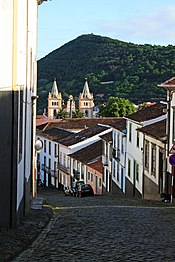
The historic eye of Angra, is located along the southern coast, encompassing the medieval urban center and fortified citadel that forms the volcanic cone of Monte Brasil. Angra is dominated past the Onetime Square (Portuguese: Praça Velha), as well known equally the Square of Saints Cosmo and Damian (Portuguese: Praça de São Cosmo e Daimão) or the Restoration Square (Portuguese: Praça dos Restoradores). Information technology was one of the offset Portuguese squares specifically designed as a broad open space, joining two of the quondam town'southward chief arteries. Angra's square is a broad and orderly, paved with Portuguese pavement stone (of white limestone and black basalt). Throughout its history, this master foursquare has had various functions: information technology was a chicken and livestock market on Sundays; during the struggles between the Liberals and the Absolutists (during the Liberal Wars) it was the site of public hangings; and the location where the local running of the bulls began. The well-planned and handsome square in Angra owes its character to the influence of the 1755 Lisbon convulsion, which resulted in the reconstruction programme that influenced many of the towns and villages of Portugal. The old foursquare (which reached its ultimate form during the late 18th century) reflects this new thinking and approach to urbanism and ship. Later on the 19th century (specifically 1879), it served every bit a central gathering identify for concerts by the war machine band of the 10th Chasseur regiment, whose barracks were in the Fort of São João Baptista.
- Building of the Angra practice Heroísmo Savings (Portuguese: Caixa Económica de Angra do Heroísmo);[vii]
- Cemetery of Anchors (Portuguese: Cemitério das Âncoras);[8]
- Customshouse of Angra do Heroísmo (Portuguese: Alfândega de Angra practice Heroísmo); synthetic to support the influx of peoples and commercial resources into the 15th century colonies of the Azores, the long-firm-like ceremonious structure was constructed in the 16th century along the Patio da Alfândega aslope the primitive wharf and Church of the Misericórida;[ix]
- Manor of D. Violante do Canto (Portuguese: Casa de Dona Violante practise Canto/Solar de Dona Violante exercise Canto);[ten]
- Manor of Madre de Deus (Portuguese: Solar de Madre de Deus), constructed by João de Bettencourt de Vasconcelos who (along with his brother-in-law, Captain-major Francisco Ornelas da Câmara) used this building in 1641 during their occludent of the fortress of São João Baptista, and carved-out trenches around the edifice in order to defend the site;[xi]
- Estate of Nossa Senhora dos Remédios (Portuguese: Solar eastward Capela de Nossa Senhora dos Remédios), a former-residence of the Canto east Castro family unit, the 16th century manorhouse was constructed from the residential home of past Pero Anes do Canto, who was nominated equally the kickoff Provisionor-of-Arms (in 1527).[12] Responsible for supporting the caravels and carracks that transited the Atlantic, the medieval post was centred in the manorhouse and his descendants expanded the grouping of buildings, including the large chapel, attributed to Pero's great-great-grandson;[12]
- Estate of the Count of Vila Flor (Portuguese: Casa do Conde de Vila Flor/Solar do Conde de Vila Flor);[thirteen]
- Palace of the Bettencourts (Portuguese: Palácio Bettencourt/Biblioteca Pública e Arquivo Regional de Angra do Heroísmo), a 17th-century building, originally a individual home, that houses the public library and regional archives, that includes a repository of 400,000 books and two meg documents;[fourteen]
- Palace of the Captains-General (Portuguese: Colégio de Santo Inácio/Colégio da Companhia de Jesus/Palácio dos Capitães Generais (SRAI)), located nigh the Largo Prior practice Crato, the 16th century building, is intimately linked to the history : it was originally the Jesuit College of Saint Ignatius and later Higher of the Society of Jesus, earlier it was abased in 1759. When the office of Captain-General was created in 1766, the building was converted into the official residence of the Crowns representatives in the Azores, controlling the armed forces, political, and administrative life of the archipelago;[fifteen]
- Residence of Quinta de Nossa Senhora da Oliveira (Portuguese: Casa of Quinta de Nossa Senhora da Oliveira)[16]
- Cais da Alfândega
- Cais da Silveira
- Câmara Municipal de Angra exercise Heroísmo
- Porto das Cinco Ribeiras
Military [edit]
The isle of Terceira, dating from the 15th century had always been susceptible to attacks by pirates and privateers, first from Barbary coast pirates, but later on by European powers who sought to capture spoils from the ships returning from the Far E. Following the personal union betwixt Espana and Portugal, post-obit the Dynastic Crisis, the need to protect the transit points of the Azores led to construction of several posts and redoubts along the coast of the island. Amidst the nearly important were:
- Castle of Moinhos (Portuguese: Castelo dos Moinhos), known equally the Castle of São Cristóvão, or Castle/Fort of São Luís, is the ruins of a 16th-century fortification overlooking the city of Angra, today surmounted by the Alto da Memória, a 19th-century obelisk dedicated to former Male monarch Peter IV of Portugal, whose forces defeated the accented monarchy of his blood brother Miguel during the Liberal Wars;[17]
- Fort of Cinco Ribeiras
- Fort of Greta
- Fort of Má Ferramenta (Portuguese: Forte de Má Ferramenta), used throughout the 16th to 20th century, the platform served for a fourth dimension during the Second Earth War before being abandoned and left to ruin;[18]
- Fort of Negrito (Portuguese: Forte practise Negrito),[nineteen] home to the Azorean Museum of War machine History, Negrito was constructed in 1581 (simultaneously with the Fort of Salga) to provide protection from the then imminent Spanish attack caused by the Succession Crunch of 1580.
- Fort of Salga
- Fort of Santa Catarina das Mós
- Fort of Santo António
- Fort of Santo António practise Monte Brasil (Portuguese: Forte de Santo António practise Monte Brasil), the small fort, which was named after António of Portugal extended the defences of the Bay of Angra by crossing-burn down with the Fort of São Sebastião, attributable to the shorter range of the former;[20]
- Fort of São Benedito practice Monte Brasil
- Fort of São Fernando
- Fort of São Francisco
- Fort of São João (Portuguese: Forte de São João), also known as the Fort of Biscoitinhos, was included in the fortification plans of Tommaso Benedetto, simply lilliputian was done to improve the big redoubt, which was mistakenly confused, at various times, with the Redoubt of Poço and/or Fort of Açougue;
- Fort of São João Baptista (Portuguese: Igreja de São João Baptista do Castelo, Fortaleza due east Muralhas); Angra do Heroísmo is dominated by the cinder cone of Monte Brasil, on which is located the fortress of São João Baptista, originally completed equally the Fort of São Filipe, during the Philippine Dynasty, under the reign of Philip II of Spain. The fortress, which includes a principal bulwark and encircled by iv kilometres (2.v mi) line of walls with four hundred pieces of artillery, used to protected shipping that returned from the East Indies (laden with gold and silvery). The fortress is dominated past the Church building of São João Baptista (Portuguese: Igreja de São Joao Baptista) and parade grounds, completed at the end of the end of the Iberian union, following the restoration of Portuguese sovereignty in 1640. At that time, the fortress was renamed to correspond with the name of the church building.[21]
- Fort of São Sebastião (Portuguese: Castelo de São Sebastião/Forte de São Sebastião/Pousada de Angra do Heroísmo)At the other end of the Bay of Angra, opposite the Porto de Pipas (Port of Barrels), is the Fort of São Sebastião, built in the 16th century on the society of King Sebastian. The scope of its cannons were interlocked with the ranges of the cannons on Monte Brasil and three other small-scale forts along the coastline, creating an constructive defensive system for the port, which had been a favourite target for pirates. The Castelo de São Sebastião has been transformed into a mannerly hotel, one of the xl-odd pousadas (inns in historic buildings) of Portugal; this transformation preserves its original historic character, but the plumbing has been modernized, and some not-visible structural elements have been strengthened.[22]
- Fort of the Zimbreiro
- Fortress of São Mateus da Calheta (Portuguese: Forte Grande de São Mateus da Calheta), role of a circuitous of six forts along the southern coast, the Great Fort was constructed after French pirates under Pierre Bertrand de Montluc attacked in 1567;[23]
- Fort of the Açougue
- Fort of the Caninas
- Fort of the Cavalas
- Fort of the Church of São Mateus da Calheta
- Fort of the Maré
- Fort of the Terreiro
- Redoubt of Dois Paus
- Redoubt of Três Paus
- Redoubt of Salga
Religious [edit]
At ane phase, Angra had as many equally nine convents, each with its own cloisters and churches. Most of these churches are from the Mannerist and Baroque periods, and they are remarkably grand if we acquit in listen the poor quality of the stone to be institute on the isle. The interior ornamentation of these churches relied on the use of both traditional carved and gilded woodwork and the rich and exotic woods of Brazil.
On the Ladeira de São Francisco in central Angra is the Igreja da Nossa Senhora da Guia (Church of Our Lady of Guia), where the seafarer Paulo da Gama is buried. He accompanied his blood brother Vasco da Gama on his first sea voyage to Republic of india in 1497.
- Chapel/Hospital of Nossa Senhora da Boa Nova (Portuguese: Capela due east Hospital Militar de Nossa Senhora da Boa Nova)[24]
- Chapel of the Misericórdia of São Sebastião (Portuguese: Capela da Misericórdia de São Sebastião e Casa de Francisco Ferreira Drumond)[25]
- Church of the Society of Jesus Higher (Portuguese: Colégio de Santo Inácio/Igreja do Colégio da Companhia de Jesus)[26]
- Convent of the Conceptionists (Portuguese: Convento das Concepcionistas)[27]
- Convent of São Gonçalo (Portuguese: Convento de São Gonçalo), established in 1542, through the initiative of nobleman Brás Pires do Canto, to shelter the Clarisse sisters, surviving to 1832 when it was the only surviving convent after the expulsion of the religious orders.[28] It is considered i of the best surviving Baroque era religious institutions in the Azores.
- Convent of Santo António dos Capuchos (Portuguese: Convento de Santo António dos Capuchos)[29]
- Hermitage of Santo Cristo do Cruzeiro (Portuguese: Capela do Cruzeiro/Ermida de Santo Cristo do Cruzeiro)[30]
- (Old) Church of São Mateus da Calheta (Portuguese: Igreja Velha de São Mateus da Calheta)[31]
Culture [edit]
Azorean bullfight [edit]

A scene from the traditional touradas à corda, where people and bulls play cat-and-mouse in the streets of parishes of the municipality
The Portuguese version of bullfighting differs considerably from its Spanish analogue, and the Azorean variety, which began on Terceira, differs from the mainland manner in some of import respects also. The Azorean bullfight ritual involves "audience participation" in a style that recalls the "running of the bulls" at Pamplona (Espana).
On Terceira, 4 fighting bulls are enclosed in dissever wooden crates for several hours and transported to the village where the bullfight volition happen, then a long stout rope is secured around each balderdash'southward cervix. Fireworks are exploded to bespeak the citizens that a balderdash volition before long be let loose in the public square. In one case the bull is released, some young men take concur of the rope to attempt to control the balderdash's head, and others taunt the bull with everything from brightly colored fighting capes to parasols. A gratuitous-for-all ensues while the bull drags some men around by the rope and tries to punish his tormenters, by butting them to the footing and goring them (with blunted horns), or by trampling over them. This is a popular leisure activity and public entertainment; it is known as the tourada à corda (English: bullfight-on-a-rope).
Somewhen, the bull is funneled through the city streets to the bullring, the Praça de Toiros da Ilha (Island Bullring), in the eastern part of Angra, where a traditional Portuguese-fashion bullfight is held. From May i to September 30, in that location are daily touradas; in fact, sometimes there are two or three in one day.
Teaching [edit]
The University of the Azores, which has its principal campus on the isle of São Miguel, has a subsidiary campus in Angra do Heroísmo, where the Department of Agrestal Sciences (Departamento de Ciências Agrárias) is located. This institution is a middle for advanced scientific and agricultural studies, and it attracts students from the entire archipelago, likewise equally strange students from many countries.
The Instituto Histórico da Ilha Terceira (IHIT), which ways, in Portuguese, the "Terceira Isle Historical Establish", is a private cultural association, defended to the investigation and study of the history of the Azores. It is organized equally an university, and it sponsors classes, lectures, and symposia on various topics. The institute was founded in 1942 past the city of Angra do Heroísmo.
Sport [edit]
Angra has a football squad, named Southward.C. Angrense, that is part of the Associação de Futebol de Angra do Heroísmo. Sport Clube Lusitânia is the main football game team on the island. The region'due south football clan is located in Angra do Heroísmo.
Twin towns — sister cities [edit]
Angra do Heroísmo is twinned with:[32]
-
 Tulare, United States, since 1966
 -
 Salvador, Brazil, since 1985
 - Taunton, Usa, since 1986
- Évora, Portugal, since 1988
- Florianópolis, Brazil, since 1994
- Gustine, U.s., since 2002
-
 São Vicente, Cape Verde, since 2003
 - Gramado, Brazil, since 2004
- Gilroy, Usa, since 2005
- Porto Novo, Cape verde, since 2011
-
 Cartagena, Colombia, since 2015
 -
 Jining, Prc, since 2015
 - Alenquer, Portugal, since 2016
- Funchal, Portugal, since 2016
Notable people [edit]


- Gaspar Corte-Real (1450 in Angra - 1501) explorer towards parts of eastern Canada.
- Brianda Pereira (ca.1550 in Angra — ca.1620) an Azorean later politicised for her function in the Battle of Salga
- António Cordeiro (1641 in Angra – 1722) Catholic priest, Azorean historian and author
- Manuel Inácio Martins Pamplona Corte Real (1760 in Angra – 1832) a nobleman and politician.
- Peter Francisco (1760 in Porto Judeu – 1831) an American patriot and soldier in the American Revolutionary War.
- Francisco Ferreira Drummond (1796 in Vila de São Sebastião – 1858) an historian, palaeographer, musician and politician
- Diogo de Barcelos Machado Bettencourt (1847 in Angra – 1922) politician and judicial magistrate
- José Júlio de Souza Pinto (1856 in Angra - 1939) a painter in the naturalist style.
- Ana Augusta de Castilho (1860 in Angra – 1916) a feminist, teacher, propagandist, freemason, and republican
- Manuel António Lino (1865 in Angra – 1927) a doc, politico, poet, dramatist and Civil Governor
- Maria Teodora Pimentel (1865 in Angra -??) first female doctor from the Azores
- Francisco Coelho Maduro Dias (1904 in Angra – 1986) a poet, painter, sculptor, illustrator, teacher, gear up designer and an overall "theatre man".
- António Dacosta (1914 in Angra – 1990) a painter, poet, art critic and pioneer of the surrealist movement
- Álvaro Monjardino (born 1930 in Angra) lawyer and politician
- Dionísio Mendes de Sousa (built-in 1940 in Vila de São Sebastião) a politician, writer, educator, and former president of the Legislative Assembly of the Azores.
- José Guilherme Reis Leite (built-in 1943 in Angra) a professor, historian and Azorean politician
- Vítor Gonçalves (born 1951 in Angra) a filmmaker, film director, screenwriter and film producer.[33]
- Helder Antunes (born 1963 in Angra) a Portuguese-American executive, computer scientist and one-time racing motorcar driver.
- Eliseu Pereira dos Santos (built-in 1983 in Angra) known as Eliseu, footballer with 355 lodge caps and 29 for Portugal
- Jaime Seidi (born 1989 in Angra) a footballer of Bissau-Guinean descent with over 170 club caps
Run across also [edit]
- Political condition of the Autonomous Region of the Azores
- Political sub-divisions of Portugal
Notes [edit]
- ^ EB (1878).
- ^ a b c EB (1911).
- ^ Instituto Nacional de Estatística
- ^ Eurostat Archived Oct seven, 2012, at the Wayback Machine
- ^ "Normais Climatológicas – 1981–2010 (provisórias) – Angra practice Heroísmo, Terceira". Instituto de Meteorologia. Retrieved November three, 2012.
- ^ "Weatherbase: Historical Conditions for Angra practice Heroísmo, Portugal". Weatherbase. Retrieved November 3, 2012.
- ^ Nóe, Paulo (2010). SIPA (ed.). "Caixa Económica de Angra do Heroísmo (PT071901160071)" (in Portuguese). Lisbon, Portugal: SIPA – Sistema de Informação para o Património Arquitectónico. Archived from the original on 2014-04-05.
- ^ "Cemitério das Âncoras" (in Portuguese). Ponta Delgada (Azores), Portugal: VisitAzores. 2013. Archived from the original on 30 December 2014. Retrieved 28 Dec 2014.
- ^ Nóe, Paulo (2012). SIPA (ed.). "Alfândega de Angra practice Heroísmo (PT071901160049)" (in Portuguese). Lisbon, Portugal: SIPA – Sistema de Informação para o Património Arquitectónico. Archived from the original on 2016-06-xxx.
- ^ Nóe, Paulo (2012). SIPA (ed.). "Casa de Dona Violante practise Canto/Solar de Dona Violante do Canto (PT071901160033)" (in Portuguese). Lisbon, Portugal: SIPA – Sistema de Informação para o Património Arquitectónico. Archived from the original on 2016-03-05.
- ^ Noé, Paula (2012), SIPA (ed.), Solar due east Capela da Madre de Deus (IPA.00008162/PT071901100032) (in Portuguese), Lisbon, Portugal: SIPA – Sistema de Informação para o Património Arquitectónico, archived from the original on iii March 2016, retrieved 18 Baronial 2015
- ^ a b Noé, Paula (2002), SIPA (ed.), Solar e Capela de Nossa Senhora dos Remédios (IPA.00008158/PT071901040027) (in Portuguese), Lisbon, Portugal: SIPA – Sistema de Informação para o Património Arquitectónico, archived from the original on four March 2016, retrieved 5 September 2015
- ^ Nóe, Paulo (2012). SIPA (ed.). "Casa do Conde de Vila Flor/Solar do Conde de Vila Flor (PT071901160036)" (in Portuguese). Lisbon, Portugal: SIPA – Sistema de Informação para o Património Arquitectónico. Retrieved thirty October 2012.
- ^ Noé, Paula (2012). SIPA (ed.). "Palácio Bettencourt/Biblioteca Pública eastward Arquivo Regional de Angra do Heroísmo (PT071901160025)" (in Portuguese). Lisbon, Portugal: SIPA – Sistema de Informação para o Património Arquitectónico. Archived from the original on 5 April 2014. Retrieved 30 October 2012.
- ^ Noé, Paula (2012). SIPA (ed.). "Colégio de Santo Inácio/Colégio da Companhia de Jesus/Palácio dos Capitães Generais (SRAI) (PT071901160026)" (in Portuguese). Lisbon, Portugal: SIPA – Sistema de Informação para o Património Arquitectónico. Retrieved 30 Oct 2012.
- ^ Costa, Patricia (2002). SIPA (ed.). "Casa da Quinta de Nossa Senhora da Oliveira (PT071901180044)" (in Portuguese). Lisbon, Portugal: SIPA – Sistema de Informação para o Património Arquitectónico. Archived from the original on 2016-06-thirty.
- ^ Leite, Antonieta (2000), SIPA (ed.), Núcleo urbano da cidade de Angra do Heroísmo/Zona Central da Cidade de Angra do Heroismo (IPA.00010623/PT071901160035) (in Portuguese), Lisbon, Portugal: SIPA – Sistema de Informação para o Património Arquitectónico, archived from the original on vi November 2013, retrieved 3 August 2013
- ^ Faria, Manuel Augusto (24–25 May 1997), "Ilha Terceira – Fortaleza do Atlântico: Forte da Má Ferramenta", Diário Insular (in Portuguese), Ponta Delgada (Azores), Portugal
- ^ Noé, Paula (2012). SIPA (ed.). "Castelo de São Sebastião/Forte de São Sebastião/Pousada de Angra do Heroísmo (PT071901130112/IPA.00033609)" (in Portuguese). Lisbon, Portugal: SIPA – Sistema de Informação para o Património Arquitectónico. Archived from the original on 1 October 2015. Retrieved 7 July 2012.
- ^ Drummond, Francisco Ferreira (1981), Anais da Ilha Terceira (fac-simil. da ed. de 1859) (in Portuguese), Angra do Heroísmo (Azores), Portugal: Secretaria Regional da Educação eastward Cultura
- ^ Silveira, Ângelo; Diniz, Sofia (2007). SIPA (ed.). "Igreja de São João Baptista do Castelo, Fortaleza e Muralhas (PT071901160001)" (in Portuguese). Lisbon, Portugal: SIPA – Sistema de Informação para o Património Arquitectónico. Archived from the original on 28 September 2011. Retrieved thirty October 2012.
- ^ Noé, Paula (2012). SIPA (ed.). "Castelo de São Sebastião/Forte de São Sebastião/Pousada de Angra do Heroísmo (PT071901040006)" (in Portuguese). Lisbon, Portugal: SIPA – Sistema de Informação para o Património Arquitectónico. Retrieved xxx October 2012.
- ^ Noé, Paula (2012), SIPA (ed.), Forte Grande de São Mateus (IPA.00033608) (in Portuguese), Lisbon, Portugal: SIPA – Sistema de Informação para o Património Arquitectónico, archived from the original on 17 October 2013, retrieved 7 July 2013
- ^ Nóe, Paulo (2012). SIPA (ed.). "Capela due east Infirmary Militar de Nossa Senhora da Boa Nova (PT071901160003)" (in Portuguese). Lisbon, Portugal: SIPA – Sistema de Informação para o Património Arquitectónico.
- ^ Nóe, Paulo (2012). SIPA (ed.). "Capela da Misericórdia de São Sebastião e Casa de Francisco Ferreira Drumond (PT071901150114)" (in Portuguese). Lisbon, Portugal: SIPA – Sistema de Informação para o Património Arquitectónico.
- ^ Figueiredo, Paula (2005). SIPA (ed.). "Colégio de Santo Inácio/Igreja practice Colégio da Companhia de Jesus (PT071901160008)" (in Portuguese). Lisbon, Portugal: SIPA – Sistema de Informação para o Património Arquitectónico. Retrieved thirty October 2012.
- ^ Noé, Paula (2002). SIPA (ed.). "Convento das Concepcionistas (PT071901040031)" (in Portuguese). Lisbon, Portugal: SIPA – Sistema de Informação para o Património Arquitectónico. Archived from the original on 7 April 2014. Retrieved 30 October 2012.
- ^ Nóe, Paula (2002), SIPA (ed.), Convento eastward Igreja de São Gonçalo (v.PT071901160007) (in Portuguese), Lisbon, Portugal: SIPA –Sistema de Informação para o Património Arquitectónico, archived from the original on 5 Apr 2014, retrieved 9 Apr 2012
- ^ Noé, Paula (2002). SIPA (ed.). "Convento de Santo António dos Capuchos (PT071901120030)" (in Portuguese). Lisbon, Portugal: SIPA – Sistema de Informação para o Património Arquitectónico. Retrieved 30 October 2012.
- ^ Nóe, Paulo (2012). SIPA (ed.). "Capela practice Cruzeiro/Ermida de Santo Cristo practise Cruzeiro (PT071901040009)" (in Portuguese). Lisbon, Portugal: SIPA – Sistema de Informação para o Património Arquitectónico.
- ^ Noé, Paula (2013), SIPA (ed.), Igreja Velha de São Mateus da Calheta (IPA.00034955) (in Portuguese), Lisbon, Portugal: SIPA – Sistema de Informação para o Património Arquitectónico, archived from the original on 27 December 2013, retrieved 25 December 2013
- ^ "Acordos de geminação da cidade de Angra do Heroísmo". angradoheroismo.pt (in Portuguese). Angra do Heroísmo. Retrieved 2019-12-12 .
- ^ Vítor Gonçalves, IMDb Database retrieved 08 August 2021.
References [edit]
- Baynes, T. S., ed. (1878), , Encyclopædia Britannica, vol. ii (9th ed.), New York: Charles Scribner's Sons, p. 46
- Chisholm, Hugh, ed. (1911), , Encyclopædia Britannica, vol. 2 (11th ed.), Cambridge University Press, p. 42
- Vilhena Barbosa, Ignacio de (1860). As cidades due east villas da monarchia portugueza que teem brasão d'armas [The Cities and Towns of the Portuguese Monarchy with Glaze-of-Arms] (in Portuguese). Vol. 1. Lisbon, Portugal: Typographia do Panorama.
- Costa, Felix José da (1867). Angra do Heroismo, Ilha Terceira (Açores): (Os seus titulos, edificios e establisementes publicos) [Angra do Heroísmo, Isle of Terceira (Azores): Its Titles, Buildings and Public Establishments] (in Portuguese). Angra practise Heroísmo, Azores.
- Gertisser, Ralf (27 August 2009). "Ignimbrite Stratigraphy and Chronology on Terceira Island". In Gropelli, Gianluca; Viereck-Goette, Lothar (eds.). Stratigraphy and Geology of Volcanic Areas. Bedrock, Colorado: The Geological Society of America. pp. 133–154. ISBN978-0-8137-2464-5.
- Gregório, Rute Dias, Terra eastward fortuna nos primórdios da Ilha Terceira (1450–1550) [Land and Fortune in the Primordial Island of Terceira (1450–1550)] (in Portuguese), Ponta Delgada, Azores: Universidade dos Açores, hdl:10400.iii/260
External links [edit]
- Explore the Cardinal Zone of the Boondocks of Angra do Heroismo in the Azores in the UNESCO collection on Google Arts and Culture
- Photos from Angra do Heroísmo
- The Azores Islands, Site with abundant information nigh Angra do Heroísmo
DOWNLOAD HERE
Posted by: hernandezsament.blogspot.com


0 Comentários